میرجعفرعلی خان حسنی
Personal Information
|
Name
|
میرجعفرعلی خان حسنی

|
|
| Born | 1691 | |
| Gender | ♂️ Male | |
| Died | 1765 | |
Parents ( 1 )
|
Father
|
حسین نجفی حسنی | |
| Siblings |
♂️ میر محمد کاظم علی خان حسنی
|
|
Spouses ( 1 )
|
Spouse
|
Unknown | |
| Children |
♂️ میر صادقعلی خان حسنی
♂️ میر مبارک علی خان حسنی |
|
Events
📍
📍
Additional Information
|
Additional Info
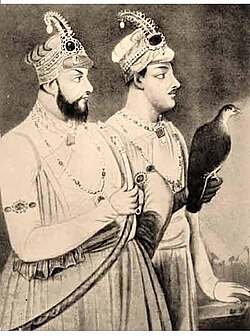
Mir JafarMir Jafar[a] (Full Name:Syed Mir Muhammad Jafar Ali Khan Bahadaur) (c. 1691 – 5 February 1765), was a commander-in-chief or military general who reigned as the first dependent Nawab of Bengal of the British East India Company. His reign has been considered by many historians as the start of the expansion of British control of the Indian subcontinent in Indian history and a key step in the eventual British domination of vast areas of pre-partition India. He is notoriously known for his betrayal of Nawab Siraj-ud-Daulah (Nawab of Bengal, Bihar and Orissa) in the Battle of Plassey.
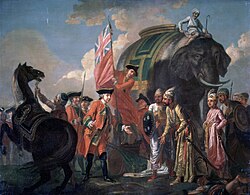
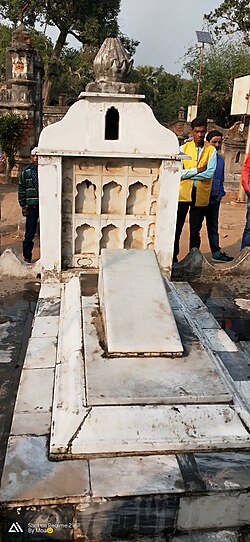
Mir Jafar served as the commander of the Bengali army under Siraj ud-Daulah, but betrayed him during the Battle of Plassey and ascended to the masnad after the British victory in 1757. Mir Jafar received military support from the East India Company until 1760, when he failed to satisfy various British demands. In 1758, Robert Clive discovered that Jafar had made a treaty with the Dutch East India Company at Chinsurah through his agent Khoja Wajid. Dutch ships of the line were also seen in the River Hooghly. Jafar's dispute with the British eventually led to the Battle of Chinsurah. British company official Henry Vansittart proposed that since Jafar was unable to cope with the difficulties, Mir Qasim, Jafar's son-in-law, should act as Deputy Subahdar. In October 1760, the company forced him to abdicate in favor of Qasim. However, the East India Company eventually overthrew Qasim as well due to disputes over trade policies. Jafar was restored as the Nawab in 1763 with the support of the company. Mir Qasim, however, refused to accept this and went to war against the company. Jafar ruled until his death on 5 February 1765 and lies buried at the Jafarganj Cemetery in Murshidabad. Due to his role in helping the British colonize India, and the eventual downfall of the Mughal Empire, Mir Jafar is reviled in the Indian subcontinent as a traitor, especially among the Bengalis in both India and Bangladesh. Nawab of BengalMir Jafar was the principal general of Alivardi Khan's successor, Siraj ud-Daulah, who led the Nawab's army to victory against the British on 19 June 1756. Governor Drake abandoned Fort William and fled with a small number of friends and principal persons, abandoning his compatriots to their fates. In spite of having led a successful attack against the Company, Jafar found himself sidelined by Siraj in favour of his rival, Raja Manikchand. A discontent Mir Jafar found support in others who opposed Siraj's tyrannical rule, from his brothers-in-arms from the Maratha Wars, to the powerful Jagat Seths. With nowhere else to turn, the plotters reached out to the Company, who had regained and strengthened their position in the region under Clive and Watson, hoping to use their military forces to their own ends. William Watts was the first to become aware of the mutterings of the disaffected nobles in Murshidabad, and sent his Armenian agent, Khwaja Petrus Aratoon, to investigate. The answer came back that Mir Jafar, in his position as the paymaster of the Bengal army, was prepared to siphon off significant amounts of money (2.5 crore rupees then, £325 million today) for help in the removal of the Nawab.
Watts wrote to Clive, who had himself observed that "he [Siraj] is a compound of everything that is bad, keeps company with none but his menial servants, and is universally hated and despised." The military under Mir Jafar, Jagat Seths as the financiers, and Clive with the mercenary army (ignoring strict instructions from London) were ready to stage a coup against the Nawab. Mir Jafar betrayed Siraj ud-Daulah to the British in the Battle of Plassey. After Siraj Ud Daulah's defeat and subsequent execution, Jafar achieved his long-pursued dream of gaining the throne, and was propped up by the East India company as a puppet Nawab. Jafar paid Rs. 17,700,000 as compensation for the attack on Calcutta to the company and traders of the city. In addition, he gave bribes to the officials of the company. Robert Clive, for example, received over two million rupees, and William Watts received over one million. Soon, however, he realized that company's expectations were boundless and tried to wriggle out from under them; this time with the help of the Dutch. However, the British defeated the Dutch at the Battle of Chinsurah in November 1759 and retaliated by forcing him to abdicate in favor of his son-in-law Mir Qasim. Qasim proved to be both able and independent-minded, although he soon came into dispute with the company over their refusal to pay taxes to Qasim. Mir Qasim formed an alliance to force the East India Company out of East India. The company soon went to war with him and his allies. The Battle of Buxar was fought on 22 October 1764 between the forces under the command of the East India Company led by Hector Munro, and the combined armies of Mir Qasim the Nawab of Bengal, Shuja-ud-Daula the Nawab of Awadh, and the Mughal Emperor Shah Alam II. With the defeat in Buxar, Mir Qasim was eventually overthrown. Mir Jafar managed to regain the good graces of the British; he was again installed Nawab in 1764 and held the position until his death in 1765.
|