This post is also available in:
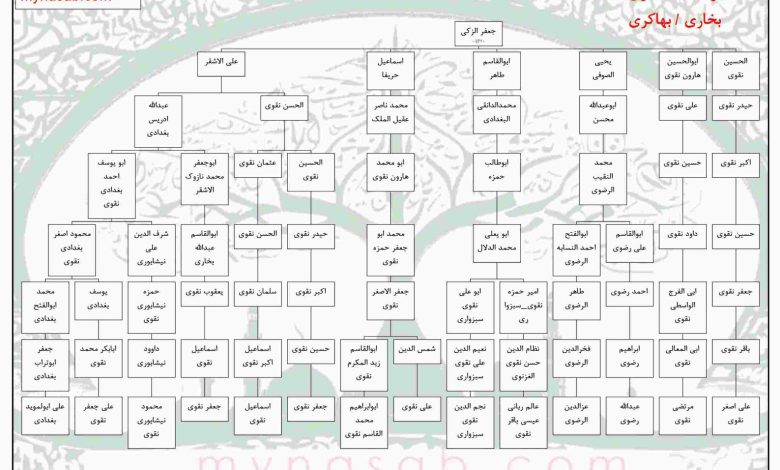
Genealogy of Naqvi Sadat the descendant of Imam Ali Al Naqi (Imam Hadi), They also called Ale Reza in some refferences.
The tenth Imam of the Shiites, Imam Ali Naqi Al Hadi (as), was born in 212 AH in the city of Surya (near Medina). His father is Imam Mohammad Taqi and his mother a virtuous and chaste lady named Samaneh. His blessed name is Ali from his titles Naqi, Hadi and Najib; And his nickname is Abolhassan.
The period of his Imamate is about 34 years, that is, from the year 220 AH (the year of the martyrdom of Imam Javad (as)) to the year 254 AH, when he was martyred in the city of Samarra.
After his martyrdom, Imam Hassan Askari (as) prayed on the holy body of his father and after the funeral, he was buried in his house.
There is disagreement about the martyrdom of Imam Ali Naqi (as) and his killer: some consider Motamed Abbasi to be the killer of that Imam (that is, this incident occurred during the caliphate of Motamed) and according to others, Mu’taz Abbasi issued the order to kill that noble man and Motamed executed it. (That is, this event took place during the caliphate of Mu’taz.)
Imam Ali Naqi al-Hadi (as) became the Imamate in the year 220 AH. At this time he was in Medina, where he performed the duties of Imamate for 13 years; He was source of spiritual, scientific and intellectual life, and he also took care of all the affairs of the Shiites, until Mutawakil (the caliph of the time) who was famous for his enmity with the Imams (as); Fearing the influence and popularity of the Imam (as) in society, he called him from Medina to Samarra because he felt that he should closely monitor the Imam. After the Imam came to Samarra, although he was apparently free, “Mutawakel” had chosen their home so that they would always be under surveillance. He regularly ordered searches of his home, and all visits were controlled by government forces.
He had created a very suffocating atmosphere in the society and put a lot of strictness and pressure on the Shiites:
Mutawakel had placed the Alawites under economic siege. He gave a lot of wealth to court poets to disrespect the Imams (as) in their poems. He had arrested and imprisoned most of Sadat at the time. One of his most horrific actions during his reign was the destruction of the shrine of Imam Hussein (as).
The living conditions of the people, especially the Alawites, were very difficult during the time of the Abbasid caliphs, especially Mutawakel and the other caliphs of Imam Hadi’s time.
wife was named Susan, brought from Noba [1] when she was a little girl. The destiny led her to Medina and the house of Imam Ali Naqi (AS) , after a while was born from her. She was one of the mystical and virtuous women of her time, she also known as “Salil, Haditha, Harbiya”. Before married that lady, said in the description of that lady:
“Salil”, that is, pulled out of every plague and filth and impurity (than, he prodict her future) and said: O Salil! It is soon for God to give you His Hujah to fill the earth with justice, after it has been filled with oppression. [2]
also praised her and said about her:
“The Susan is free from evils and impurity.”
Susan was so virtuous that when Imam Hassan Askari (AS) was martyred, she was considered as a refuge for Shiites. Ahmad Ibn Ibrahim says: I asked Hakimah,the daughter of Imam Javad (AS): In this period of Shiite anxiety and worry (during the absence of Hazrat Wali Asr), to whom should the Shiites refer? He replied: “To the Umm Abi Muhammad.”
In the year 259 AH. Imam Hassan Askari (AS) sent Susan and Imam Zaman to Hajj and before leaving, he handed over the great name, weapon, etc. to Hazrat Mahdi (as).
Susan and her grandson traveled to Mecca and then to Medina. There she learned that his beloved child () had been martyred; So she hurried to Samarra.
When she reached Samarra, she realized that Ja’far al-Kadhab was claiming the inheritance and guardianship of and introduced himself as the guardian and heir of the Imam.
Susan went to Jafar Kadhab and said: “I am the guardian of.” Jafar did not accept. To prove her claim, she went to Abu al-Shawarib, the judge of Samarra, and proved her will.
Susan commanded: Whenever I die, bury me next to the grave of my husband and my son Imam . When she passed away, they wanted to carry out her will. Jafar Kadhab refused to bury Susan on the pretext that he was the heir of his brother and the owner of the house. At this moment, by the order of the Lord, Hazrat Mahdi (AS) appeared and addressed his illegitimate uncle: “O Ja’far! “Is this your house or my house?” And disappeared from view. Impressed, Jafar withdrew and Susan was buried with her innocent husband and child. [3]
Most scholars have mentioned four sons for Imam Ali Naqi Al Hadi (as), but there is a difference in the number of his daughters.
Hazini writes: The sons of Imam Hadi (AS) are: Imam Hassan (AS), Muhammad, Hussein and Ja’far [4]
Sheikh Mofid writes: His successor is Hazrat Abu Mohammad Hassan, who is the Imam after him, and Hussein, Muhammad, Jafar and a girl named Aisha. [5]
Apart from Aisha, Sheikh Tabarsi also introduces a girl named Dalala as the daughter of Imam Hadi (AS). [6] And Ibn Shahr Ashob names a girl named Aliyah for them. [7]
Of course, according to the evidence, it is possible that Imam Hadi (AS) had only one daughter who had different letters. The words of Sunni scholars also use the fact that Imam Hadi (AS) had four sons and a daughter named Aisha [8].
Ibn Anba believes that the generation of Imam Hadi (AS) continued through his two children (Imam Hassan Askari and Ja’far). [9]
Imam Hassan Askari was born in Medina on the eighth Friday [10] of the second month of Rabi al-Thani in the year 232 AH. [11]
His dear mother, “Hadith”, was a noble, pious and virtuous lady. her other names are “Susan”, “Salil” and “Jeddah”.
His childhood was spent under the tutelage of his noble father Imam Hadi (AS). Imam Hadi (AS) says about his son:
“My son Abu Muhammad is the most noble face of the family of prophethood and the most steadfast authority (of God). He is the eldest of my children and my successor, and the Imamate and the rules return to him. “[12]
Many narrations have been narrated from Imam Hadi (AS) in which the Imamate and leadership of Imam Hassan Askari (AS) has been emphasized. Saqr ibn Abi Dalf says: I heard Imam Hadi say:
The Imam after me is Hassan and after Hassan, his son is “Ghaem”; One who fills the earth with justice; As if it is full of oppression. [13]
Imam Hassan Askari (AS) was the most devout person of his time and he mostly worshiped God and carried out divine commands. He recited the Qur’an, prayed and prostrated to God at night until morning. The first prayer took precedence over anything else, and whenever he stood up to pray, he prayed with all his might, and until he finished the prayer, nothing caught his attention. Abu Hashem Jafari says:
I was honored to serve Imam Hassan Askari (AS). Imam was writing something. When the time for prayer came, the Imam stopped writing and stopped praying. [14]
Generosity is the Crimean morality of Imam Hassan Askari (AS). He was the most generous people of his time. No poor and empty-handed person returned from that Imam’s house empty-handed. He tried to help them before poverty was expressed. In most Islamic areas, he appointed lawyers to collect sharia rights from the people and deliver them to the poor and helpless, and allowed them to use the property to resolve disputes between Muslims and other good causes. [15]
According to some sources, Syed Muhammad, around the year 228 AH. Was born. [16] According to this saying, Sayyid Muhammad is the first child of the Imam; But according to some narrations, Seyyed Mohammad was the second child and younger than Imam Hassan Askari (AS). Ali ibn Mahziar narrates: I said to Imam Hadi (AS): If you die, to whom should we refer?
The Imam said: “Ahdi al-Akbar from my son.” [17]
Syed Muhammad was so great and glorious that the Shiites thought he was the next Imam. The companions of Imam Hadi (AS) also asked the Imam about his Imamate. Ali ibn Amr Nawfali says:
We were with Abi Al-Hassan (AS) in the yard of their house when his son Muhammad passed in front of us. I said: I beg your pardon, is this our Imam after you? The Imam replied: No, your Imam after me is good [18].
Imam Hadi (AS) and his son Imam Hassan Askari (AS) were very interested in Muhammad; So that the Imam held a final assembly for him. Some have quoted Bani Hashim, including Hassan bin Hassan Aftas:
On the day of Sayyid Muhammad’s death, we went to the house of Imam Hadi (AS) and saw that there were large benches in the courtyard of the house and people were sitting around. We estimated the population, except for Mawlawi and other people, 150 people from Abi Talib, Bani Hashem and Quraysh. Suddenly, Imam Hassan (AS) entered and stood next to his father. We did not know the Imam. After an hour, Imam Hadi (AS) turned to him and said:
Imam Hassan (AS) cried and said: “Praise be to God, the Lord of the worlds.
I asked: Who is he? They replied: Hassan (AS), the son of Imam Ali Al-Naqi (AS). He seemed twenty years old at the time, and we realized that after his father, he was the Imam. [19]
Sayyid Muhammad in the year 252 AH. He intended to travel to visit the house of God. When he reached Balad village, he fell ill and died. The Shiites buried him there. [21]
Many miracles have been seen from this noble son of Imam Hadi (AS), Mirza Hussein Nouri writes in Al-Najm Al-Saqib:
Sayyid Muhammad is the possessor of frequent honors and is even famous among the Sunnis. The Iraqi people, even the Bedouin Arabs, are afraid to swear by his name. If they are accused of embezzling money, they will return it, but they will not swear allegiance to Sayyid Muhammad; Because they have seen its torment. [22]
A number of scholars have written books about the virtues of Sayyid Muhammad; Including: A treatise on the miracles of Sayyid Muhammad ibn Ali al-Hadi, written by Mahdi al-Abd al-Ghaffar Kashmiri. Here is an example of his miracles:
Allameh Seyyed Hadi Khorasani Bajestani [23] quotes Seyyed Hassan Al-Khoja, the God of Astaneh Askari (AS):
I was sitting in the noble courtyard of Abi Jafar Seyyed Mohammad. I noticed an Arab man entering the threshold with one of his arms around his neck. I approached and asked about the cause of his illness. In response, he said: Last year, one day I went to my sister’s house. I saw a sheep tied up in the yard. I wanted to slaughter and eat, but my sister did not allow it and said: This sheep is the vow of Sayyid Muhammad. I did not pay attention to what he said and slaughtered it. After three days, Shelley’s marks appeared on my hand and it got worse day by day. I did not understand the reason, until recently I realized my action. Now I regret it and came to the doorstep of Seyyed Mohammad for healing. Then he entered the shrine with his companions and they started crying and wailing. After an hour I saw him move his hand. He performed the prostration of sugar and vowed to bring a sheep every year and slaughter it with the intention of Sayyid Muhammad. [24]
We have not received much information about Hussein ibn Ali (AS). Sheikh Abbas Qomi writes:
“It is known that near the grave of the Askaris, there is a sentence from Sadat al-Azam, among whom is Hussein, the son of, and I was not informed about Hussein, but what seems to me is that Sayyid Jalil al-Qadr and It was great; Because I used some narrations that interpreted and compared our master Imam Hassan Askari and his brother Hussein Ibn Ali to Sobtin and compared these two brothers to their two ancestors, the two lineages of the Holy Prophet (PBUH) Imam Hassan and Imam Hussein (AS).
And in the narration of Abu al-Tayyib, the voice of Hazrat Hojjat (peace be upon him) was similar to the voice of Hussein, and in the genealogy of the saints, it is written by the jurist, narrator, and sage Sayyid Ahmad Ardakani Yazdi, mentioning the descendants of , whose son Hussein , He was one of the martyrs and worshipers and he confessed to the Imamate of his brother and maybe he will find a skilled follower other than what was mentioned, something that indicates his glory “. [25]
Jafar is known in history as Jafar Kadhab. Narrations from the Ahl al-Bayt (AS) have also been included in his condemnation. Ibn Siyabah says:
“When Jafar wanted to be born, I was in the house of. I saw that everyone at home is happy; But the Imam was not happy. I said: O Sayyid and my lord! Why are you not happy about this birth? The Imam said: “Yahweh, may God bless you and grant you peace.” [26]
Some narrations are used that during the life of he tried to introduce himself as the Imam after his father. Ahmad ibn Sa’d Kufi says:
“We came to with a group of Shiites and asked him about the Imamate after him, and we said that some people say that the Imam after you is Ja’far and not Hassan.
The Imam said: [Avoid this], Ja’far is my enemy; Although he is my child. He is also the enemy of his brother Hassan and his Hassan is the Imam after me … “. [27]
Imam Hadi (AS) also says in another narration:
“Stay away from my son Ja’far, be aware that his relationship [to me] is like that of Ham to Noah.” [28]
Abu Khalid Kabuli also narrates from Imam Sajjad (AS) that the Holy Prophet of Islam, when introducing the Imams after him, said the following when mentioning Imam Sadegh (AS):
“… Ja’far ibn Muhammad, who is called Sadegh. So for his fifth child ()) there is a son named Ja’far who claims to be the Imamate and lies to God! “He is also against his father and his brother jealous ….” [29]
In history or in the words of Ahl al-Bayt: nothing has been entered in this regard. Only Ali Alawi Omari writes in Al-Majdi in Al-Ansab:
“There is a saying that he returned before his father and repented, but after the martyrdom of his brother , because he thought he had no children, he claimed the Imamate after his brother and became known as a liar.” [30]
Ahmad Ibn Ishaq, the lawyer of says:
Jafar Kadhab had written a book and claimed that in this book, halal and haram knowledge and all sciences have been written forever. I read the book and wrote a letter about it to Imam al-Zaman (as). The Prophet wrote in reply:
“… It is clear from the phrase in the book who wrote it. May God protect the truth over its people! God is reluctant to combine the Imamate between two brothers, after Imam Hassan and Imam Hussein … “[31]
Ja’far died in Samarra in 271 AH at the age of 45. He was buried next to his father’s grave in Samarra. [32]
As mentioned had four sons but according to the scholers his the generation continued through two of his children and
شجره سادات بخاری (نقوی)
اولاد جلال الدین سرخ پوش بخاری
سادات بهکری نقوی
اولاد محمد حسین بکهری نقوی

سادات گردیزی نقوی
Notes [1]. Nuba is the name of a vast land in southern Egypt. The Holy Prophet of Islam praised the people of that land and said about them: “Whoever does not have a brotherhood should take a person from the people of Noba as a brother.
[2] . کشفالغمه، ج 3، ص 197؛ منتهى الآمال، ج 2، ص 701 و…
[3] . زنان مردآفرین، محمد محمدى اشتهاردى، ص 185.
[4] . الهدایة الکبراى، ص 313، س 12.
[5] . الارشاد، ص 334.
[6] . دلائل الامامة، ص 412.
[7] . المناقب، ج 4، ص 402.
[8] . الفصول المهمة، ص 283؛ الصواعق المحرقة، ص 207؛ ینابیع المودة، ج 3، ص 129، نور الابصار، ص 337.
[9] . عمدة الطالب، ص 179.
[10] . بعضى از مورخین روز ولادت آن حضرت را دهم ربیع الثانى، بعضى روز چهاردهم همان ماه و بعضى روزهاى دیگر گفتهاند؛ ولى مشهور همان روز هشتم ربیع الثانى است. (بحارالانوار، ج 50، ص 235
[11] . الارشاد، ج 2، ص 313؛ بحارالانوار، ج 5، ص 235؛ منتهى الآمال، ج 2، ص 701 و… .
[12] . اعیانالشیعة، ج 2، ص 41.
[13] . همان، ج 50، ص 239.
[14] . بحارالانوار، ج 50، ص 304؛ اثبات الهداة، محمد بن حسن حر عاملى، ج 3، ص 430،.
[15] . الامام الحسن العسکرى، ص 40؛ مناقب آل ابىطالب، ج 4، ص 423.
[16] . دایرة المعارف تشیع، ج 3، ص 410.
[17] . موسوعة کلمات الامام الهادى، پژوهشکده باقر العلوم، ص 126.
[18] . کافى، ج1، ص 325
[19] . بحار الانوار، ج 50، ص 245؛ منتهى الآمال، ج 2، ص 688.
[20] . هم اکنون شهر بلد در هشتاد کیلومترى بغداد و در مسیر بغداد ـ سامرا قرار دارد. اکثر اهای این شهر کوچک شیعه هستند و ارادت ویژهای به سید محمد عابد دارند.
[21] . المجدى، ص130.
[22] . ابو جعفر محمد بن على الهادى، غروى اردوبادى، ص 40.
[23]. زندگی این عالم بزرگوار در گلشن ابرار جلد5، ص329. آمده است.
[24] . همان، ص 42.
[25] . مفاتیح الجنان، ص 1012.
[26] . اکمال الدین و اتمام النعمة، ص 321.
[27] . الهدایة الکبرى، ص 320.
[28] . همان، ص 381.
[29] . اکمال الدین و اتمام النعمة، ص 219؛ اثبات الهداة، ج 1، ص 275، ح 129.
[30] . المجدى فى الانساب، ص 130.
[31] . الغیبة، شیخ طوسى، ص 287.
[32] . همان، ص 84.
This post is also available in: