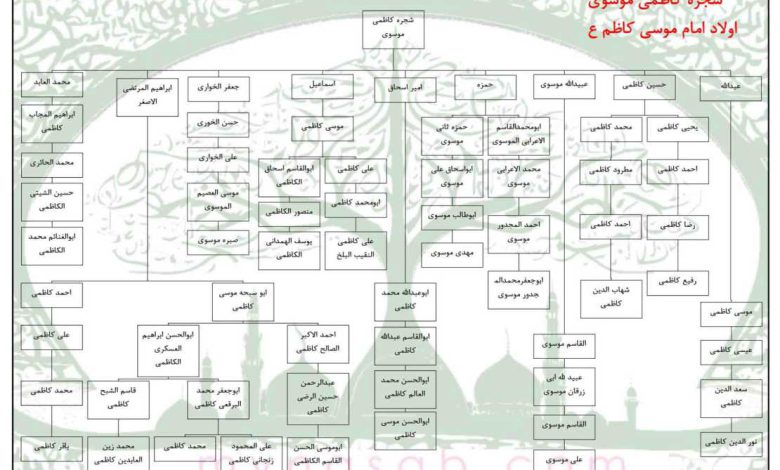
Hazrat Musa bin Jafar (128-183 A.H.) nicknamed and famous as “Imam Kazem”, is the seventh Imam of the Shiites. Imam Kazim reached the Imamate after the martyrdom of his father, Imam Jafar Sadiq (peace be upon him). He led the Shia for 35 years from 148 to 183.
He was a contemporary of four of the Abbasid caliphs, all of whom were opposed to the Shia and put a lot of pressure on Imam Kazim and his companions. And finally he was martyred during the caliphate of Harun al-Rashid and with his conspiracy.
Hazrat Musa bin Jafar (peace be upon him) as mentioned in some sources born in 7th of Safar and ; in others as Dhul Hijjah (without specifying the day). The Year of birth was also disputed said by some to be 127 Hijri and by others 128 Hijri .
His son of Imam Sadiq (peace be upon him) and Hamida known as Hamida Berbariya or Hamida Musfat .
His nickname was Abu Al-Hasan I, Abu Ibrahim, and Abu Ali, and Musa bin Jafar, Kazem, Abd Salih, Nafs Zakiya, Zain al-Mujtahidin, Wafi’, Saber, Amin, and Zaher.
Rabi bin Abd al-Rahman said: By God, Musa bin Jafar, was one of those who could see the signs of majesty and perfection of knowledge and knowledge of the truths of the world in his face ; and he knew who would claim his position and deny the Imamate and his successor . But He suppressed his anger and did not express what he knew, that is why he was nicknamed Kazem.
has been quoted as saying: The inscription on the ring of my father Musa bin Jafar was “Hasbi Allah”; at this time the Imam opened his hand and showed the ring and I saw its inscription.
Hazrat Abul Hasan Musa had thirty-seven sons and daughters, which are:
1- 2- 3- Abbas 4- Qasim 5- 6- 7- Harun 8- Hassan 9- Ahmad 10- 11- Hamza 12- Abd Allah 13- 14- Obaidallah 15- Zayd 16- Hassan 17- Fazl 18- Hossein 19- Suleiman 20- Fatimah Kobri 21- Fatimah Sughri 22- Ruqiyeh 23- Hakimah 24- Umm Abiha 25- Ruqieh Sughri 26- Umm Jafar 27- Lababa 28- Zainab 29- Khadijah 30- Ali 31- Amina 32- Hasna 33- Barihe 34- Aisha 35- Umm Salma 36- Maimuneh 37- Umm Kulthum.
Among all the children of Hazrat Abu Al-Hassan , his noble son Hazrat was the most honorable, the most powerful, the wisest and the most virtuous.
His other son Ahmad bin Musa (Shahcheragh) also a noble and pious man, and Hazrat Musa bin Jafar loved him and put him first over other children, and gave him his Bostan Yasir.
Among the daughters, Hazrat Masoumeh considered as one of the most virtuous women of the Ahl al-Bayt family.
Imam Kazem’s encounters with Bani Abbas
After the martyrdom of his father Imam Sadiq in 148, Imam Kazem took over the Imamate ; during the time of Mansoor Davanighi. Mansur Abbasi died in Mecca in 158. His successor until 169 was his son Mehdi Abbasi. After that, Hadi Abbasi became the caliphate for one year and then Harun succeeded to the caliphate. Imam martyred by Harum Al Rasheed in 183.
The era in which Imam Kazem lived coincided with the first stage of tyranny Abbasid rulers. These oppressions, from the time of Imam Sadiq and continued until the time of Imam Reza , which was the period of Ma’mun’s caliphate.
People felt some political security during Ma’mun’s time, but soon the caliphate started putting pressure on the people. The political pressure of the Abbasids began in a period when Imam Baqir and Imam Sadiq had strengthened the scientific and hadith foundation of Shia. The mission of Imam Musa Kazem was to establish balance and intellectual balance among Shiites in this scientific movement.
The era of Imam Kazim considered as difficult time for the Shiites. During this period, there were many Shiites and Alawites uprisings against the Abbasid caliphs. The most important of which were the Fakh uprising – during the rule of Hadi Abbasi – and the movement of Yahya and Idris sons. It was Abdullah that happened during Harun’s time. In fact, the most important rival of the Abbasids were the Alawites
This situation caused Imam Kazem to take the path of taqiyyah to manage the Shia organization and their leadership secretly. Naturally, this situation caused history to not be able to make an accurate assessment of Imam’s political movements. And that’s why there are few historical documents about this.
Another type of interaction of Imam Kazim with the Abbasid caliphate was the move that the Imam had in dealing with Ali Ibn Yaqtin and asked him to stay in the Abbasid court and try to save the Shiites from trouble.
Ali bin Yaqtin was one of the special companions of Imam Kazim , who was influential in the Abbasid caliphate. He had a lot of influence during the period of Mahdi and Harun and used it for the benefit of the Shiites. When he asked the Imam to allow him to leave the service of the Caliphate, the Imam refused to give such permission and said: Do not do this as we have taken you there and you are a source of honor for your brothers (Shiites) and maybe Through you, God will make up for the failure of his friends and kill the conspiracies of the opponents about them. O Ali! Atonement for your sins is good for your brothers.
Imam Kazem imprisoned twice by Harun al-Rashid, the second time from 179 to 183; That is, it lasted for four years and led to his martyrdom. The duration of Imam’s first imprisonment is not specified.
The reasons for the imam’s imprisonment on these two occasions, both of which by Harun, mentioned as follows:
Harun, with all his power and authority, had to make such justifications so that his action would not be denied and hated by the people. In the same mosque, Harun issued an order to arrest the Prophet. He ordered two caravans to be prepared, one to be sent to Kufa and the other to Basra. He sent Imam along with one of these two caravans. This work was done for the reason that people do not know where the imam is imprisoned.
He sent Imam Kazim to the ruler of Basra, Isa bin Jafar bin Mansour; Imam spent some time in his prison, but eventually, Jesus got tired of this work and wrote to Aaron to hand him over to someone else. Otherwise, he will release him, because all this time he tried to get a witness against the Imam, but he did not find anything.
After that, the Imam was handed over to Fazl Bin Rabi. Imam was imprisoned by him for a long time. It is said that they asked him to kill that Prophet, but he refused to do so. After that, he was handed over to Fazl bin Yahya and he spent some time in his prison. According to historians, he respected the sanctity of the Imam. After that, Imam Kazem handed over to another jailer named Sandi bin Shahak.
Although Imam Sadiq in private meetings with some of his special companions such as Mufadl bin Umar Jaafi, Muaz bin Kathir, Abdul Rahman bin Hajjaj, Faiz bin Mukhtar, Yaqub Siraj, Sulaiman bin Khalid, Safwan Jammal, Ishaq and Ali – who are brothers Imam Kazim has been – he mentioned the imamate of his son Imam Kazim, but at the same time due to political reasons, including the fear of Abbasid rule, Imam for many Shiites He remained unknown; Because it was possible that if the imamate of Imam Kazim (peace be upon him) was determined openly and in public, he would be under pressure from the caliphs.
Among the reasons for the confusion of Shiites after Imam Sadiq, the following can be mentioned:
These factors worked hand in hand and were very effective in creating a split among the Shiites after the martyrdom of Imam Sadiq (peace be upon him), so that one of the companions of Imam Kazim said: “Zhab al-Nas after Abi Abdullah is on the right and the north.”
Nubakhti counts the division of Shia into six sects after the death of Imam Sadiq (peace be upon him) as follows:
Among the Islamic schools of thought that were found at the end of the first century of Hijri and had a major contribution in the intellectual conflicts of the Islamic society after that, was the Mu’tazila religion, the basic principle of this religion was to justify religious issues in the shadow of reason, which is to leave religious categories in the hands of reason. , in such a way that rational analysis and justification of these categories go to extremes, it could not produce favorable results.
One of the examples are the types of beliefs that were raised by these rationalists about monotheism. Sometimes they attributed opposite attributes to God and sometimes they took away some of the attributes that God attributes to them according to the Qur’an. This movement was not acceptable for the Shiites who had an infallible Imam. In the Shiite culture, fundamentalism, in the sense of paying attention to the hadiths of the Messenger of God, peace and blessings of God be upon him, was considered one of the most basic principles. In addition to that, the imams themselves also provided rational justifications in defense of the truth of Islam. In the same context, students were also trained whose mission was to rationally defend the religion and beliefs of the Shia religion.
Against the Mu’tazila, there were groups of Ahl al-Hadith who were plagued by many fake hadiths and were plagued by many doubts and problems in the matter of monotheism. Those who were suspicious and tried to carve out human and material attributes for God by comparing them to the appearances of verses and traditions, the Imam took a stand and made God exempt from any kind of similes and material attributes.
Imam Musa Kazim (peace be upon him) said against these two groups and in the topic of monotheism in general: “Do not exceed in monotheism our dhikr of Allah Almighty in the Book of Fathalk; in the matter of monotheism from what God the Exalted and Exalted in His Book It has been mentioned that don’t step beyond that you will perish.” Or they say: “Indeed, Allah is the highest and the most important is that He should convey His Attributes, so that He can tell the truth about His Attributes. So know him as he described himself and stop doing anything else.” And when the imams themselves wanted to enumerate the attributes of God, they used only the themes of the Qur’an.
Martyrdom of Imam Kazem (peace be upon him)
About the quality of martyrdom of Imam Kazem , three different narrations have been narrated:
The shrines of Imam Musa Kazem and Imam Javad in Kazmin
In this regard, the most famous narration is the poisoning of the Imam. After the Imam’s martyrdom, the holy body of the Imam was exposed to the eyes of the people of Baghdad and the general public for two reasons:
According to Arbali’s writing, Sandi bin Shahak brought the jurists and jurists of Baghdad, among whom Haitham bin Udi was also seen, over the holy body of the Imam, to see that there were no wounds, injuries or signs of suffocation in the body of the Imam, and to death. He passed away naturally.
Also, because some of the Shiites believed in the Mahdism of the Prophet or there was a possibility that they would believe in his Mahdism, they put the Imam’s body on the ground on the bridge of Baghdad and Yahya bin Khalid ordered them to shout: This is Musa bin Jafar, who is the Prophet. They believe he is not dead. After that, people came and looked at him while he had passed away. Then they buried the body in the “Bab al-Tin” of Baghdad in the Quraish tomb.
The date of martyrdom of Imam Kazim according to the narration of Sheikh Sadouq was 25 Rajab 183 lunar month and according to the narration of Sheikh Mufid 24 Rajab, and according to Mustafa, it was Friday 14 Safar.
We are intent to compile and build a complete Sadat genealogy. Every bit of information would be valuable to form a database and eventually a family tree.
Please , and share your ancestor’s information and be a part of the movement; to form the most reliable and comprehensive database of Sadat.
سادات همدانی کاظمی
This post is also available in: