This post is also available in:
The Sayyids are by definition a branch of , which traces its lineage to Adnan, and therefore directly descends from Ishmael (Ismâ`îl), and collaterally descends from his paternal half-brother Isaac (Isha’aq), the sons of Abraham (Ibrahim) [citation needed].
is the clan of Muhammad, whose great-grandfather was Hashim ibn Abd Manaf, for whom the clan is named. Members of this clan are referred to as Hashemites. Descendants of Muhammad usually carry the titles Sayyid, Syed, Hashmi, Sayed or Sharif, or the Ashraf clan (synonymous to Ahl al-Bayt)
It is now common for those named Sayyid to be related to the , and in this case, most of the Sadat have genealogies. Practical treatises also mention ways to assert the sovereignty of individuals, including genealogy and the notoriety of sovereignty in a place where it is said that the father and grandfather of this person were Sayyids. Of course, in the past, the Sadat lineage was more strict than in this era.
Rule of attribution to the last Imam
Every Seyyed Mousavi is also Hosseini; But he is called Mousavi, not Hosseini. The reason for this is the existence of a rule in the science of genealogy, according to which Sadat is attributed to the last Imam in their genealogy; For example, a person who is a descendant of Imam Musa Kazem (AS) is called Mousavi and not Hosseini (attributed to Imam Hussein) or Alavi (attributed to Imam Ali).
Sadat Population around the world
Statistics show that the population of Sadat in the world today is over 3 million people; This means a family of millions. In the world, in South Asia, up to 4 million, in Egypt, up to 4 million, in Morocco, up to 3 million, in Yemen, Afghanistan, Indonesia, Malaysia and Brunei, up to 3 million, in India and Pakistan, up to 4 million, and in Bangladesh, up to 3 million. There are millions of Syeds. According to the latest statistics, Sadat’s population in Iran is over 2 million people. Among Muslims, especially Shiites, Sadat has special respect and esteem. For some, the question may arise as to where the title Sayyid came from and how one can prove that Sayyid is a family. You will find the answers to your questions below.

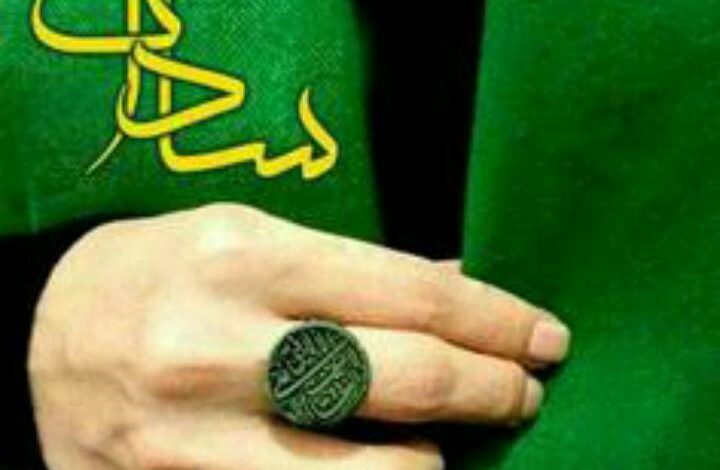
Sadat and Alawites have had symbols and slogans throughout history, with which they were known, such as: registering their names in a special book called a Naqib or hanging long braided hair on the sides of the face. Nowadays, Sadat clerics are known for wearing black turbans and ordinary people for wearing green clothes, hats or scarves.
Family tree and linage Records
There was an institution called the “Sadat Niqab” for each city, which was called Naqib al-Sadat. They were called Naqib al-Naqba ‘, Which held records of the Sadat family tree information and the linage. Sadat’s Naqib al-Sadat or genealogy institute was created in 251 AH, during the Abbasid rule and during the caliphate of Musta’in Abbasi, with his agreement and signature, and became one of the official rituals and organizations of the Abbasid rule. This organization was set up to register Sadat, administer him, and pay him some religious funds.
Sadat’s first naqib, Sharif Abu Abdullah Hussein ibn Abi al-Ghanaim Ahmad, known as Nahrshabusi, was a descendant of Zayd Shahid and nephew of Yahya ibn Umar, who revolted in 250 AH. Abu Abdullah ibn Hussein, when he saw the weakness of the Abbasid supporters, went to him and offered to form the mask of Sadat Alavi. The first Naqib Sadat Alavi wrote a book called Al-Ghosun fi Shajra Bani Yasin in Sadat genealogy.
Narrations about Sadat
It has been narrated from the (peace and blessings of Allah be upon him) that any cognation or relationship of the groom will be broken on the Day of Judgment except his kinship with me, whether it is relative or causal (which is also established there). Mufaddal ibn Umar says: I heard from Imam Sadiq (as) that none of the children of Fatima (as) would die until she confessed to the Imamate of her right, just as the children of Ya’qub (as) did not die until they succeeded in repenting.
Bazanti says: I was sitting in the service of Imam Reza (as). There was talk of Sadat. He said: No, our good deeds are doubled and our evil deeds are doubled. Fadl ibn Yunus says: Imam Kadhim (as) entered my house, they were sitting in a group. I wanted to put him at the head of the assembly. Imam Said: The owner of the house has priority at the (Sadr) head of the group, except there is a man from Bani Hashemi, and I said: So Sadr is your right.
Tesayyud
Within the Footrest Realm, assess breaks for “the Individuals of the House” empowered numerous individuals to purchase certificates of plunge or fashion family histories; the wonder of teseyyüd – dishonestly claiming respectable family line – spread over ethnic, class, and devout boundaries. Within the 17th century, a Footrest bureaucrat evaluated that there were 300,000 impostors. In 18th-century Anatolia, about all upper-class urban individuals claimed to plummet from Muhammad.
Maternal descendance
Agreeing to Iran’s devout pioneer and the Deobandi creed—a statement of faith particularly taken after by patriarchal Pashtun tribes—the status of being a Sayyid can as it were be ascribed through patrilineal ancestry. Agreeing to Shia conclusions, children of a Sayyida mother and a non-Sayyid father are alluded to as Mirza.[citation required] The Persian documentation “Mirza”, which may be a determination of the word “Mirzada” (i.e., Child of a “Mir”) has different implications: one could be a Sayyid pioneer of a Sayyid department or community, at the same time being a devout Islamic researcher. Hence, a Sayyid of patrilineal heredity, being the child of a Mir, can moreover be called “Mirza”.
This illustration substantiates the truth that there are distinctive conclusions concerning the transmission of the title Sayyid. Another verifiable supposition of Hassock Naqib al Ashrafs communicates that children of maternal prophetical plummet are called Sharif.
However, in 1632 when a Hassock court challenged a man wearing a Sayyid’s green turban, he built up that he was a Sayyid on his mother’s side, which was acknowledged by the court.
In patriarchal social orders, ladies ordinarily ought to absorb themselves into their husband’s status. However, this does not influence female relatives of Muhammad because it is seen as a sacrosanct blood connection. In this way, the heraldic title can be given to a person through his or her mother’s line in understanding to Footrest Naqib al-Ashrafs. Indeed the Zaynabids, the relatives of Woman Zainab, the girl of Ali ibn Abi Talib can moreover be titled Sayyid or Sharif, concurring to the Egyptian Al-Suyuti. In Tajikistan, matrilineal relatives are respected.
This post is also available in:


